AI Image Prompts for Weather: Rain Has to Land on Something
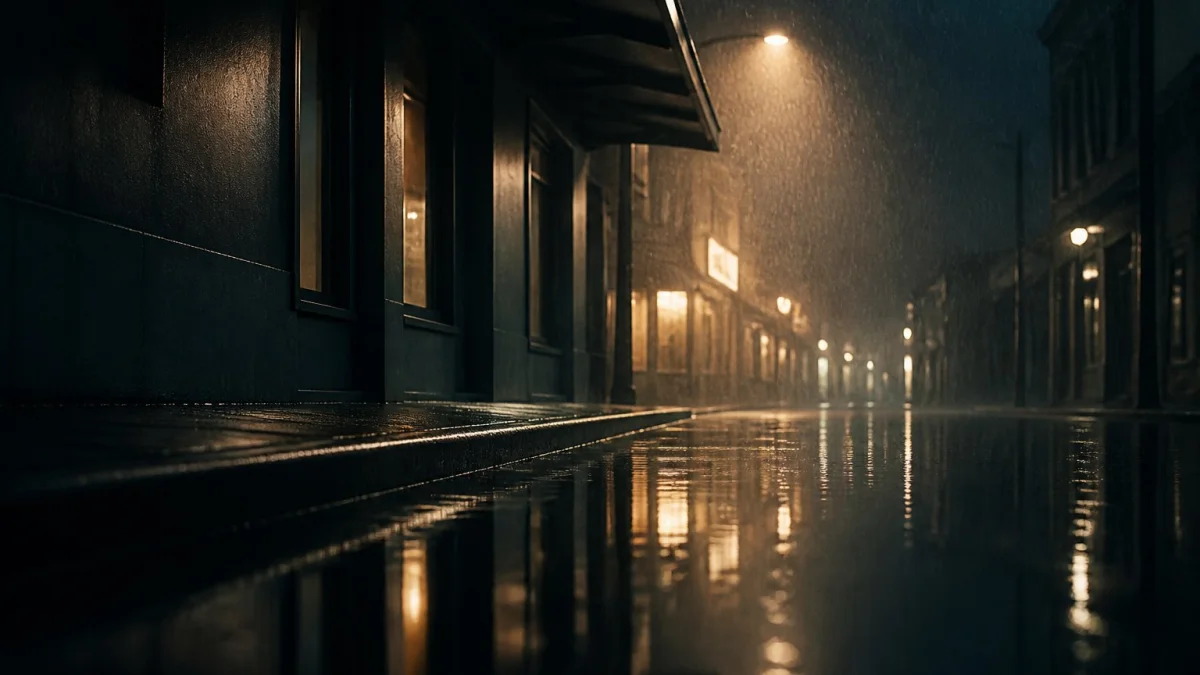
Image generated with AI.
A prompt that says "rain" comes back as grey haze. Rain only reads when it lands on something, is lit from behind, and turns the ground into a mirror.
Ask an image model for rain and you get a grey sheet with white streaks in front of it. Weather is not a word you write into a prompt. It is a set of consequences. Good AI image prompts for weather read like short physics problems, not forecasts.
The word names a phenomenon, the model has a cheap cliche for it, and the result looks like a cloud icon: recognisable and inert.
AI Image Prompts for Weather: A Consequence, Not a Word
"Rainy" classifies the world and gives the model no instruction it can draw. Faced with a category, it reaches for the cheapest visual it has: for rain a veil, for snow white speckle everywhere.
What an eye reads as weather is three things, every time. Where the water landed. What stood behind it so it could be seen. And what it did to the light, arriving and coming back off the ground. One-line test: if you can delete the weather word and the image would not change, the weather was never in the image. It was in the caption.
The Three Traces Every Weather Leaves
First, landing: water only wets what faces up, and snow only collects on a horizontal face. Second, background: falling water is invisible by itself and needs something on the far side. Third, the light: wet ground returns what is distant, snow bounces light upward, and haze removes contrast with distance rather than detail in place.
Rain: The Ground Is the Proof
The most common failure is the evenly shiny floor. A prompt says "wet asphalt" and the model obliges with a uniform gloss reflecting the sky in every direction. Real wet ground behaves like a mirror whose strength depends on the viewing angle, which is what the Fresnel equations describe: how much light is reflected and how much enters depends on how that light arrives.
The consequence is narrow: seen almost edge-on the wet street returns a lot, seen from directly above the puddle at your feet returns little. So the reflection belongs in the lowest band of the frame, stretched away from the camera, and it should contain the distance: lit windows, signboards, the last streetlight. Not the sky.
Why Wet Asphalt Mirrors the Far Side and Not Your Feet
Because the reflective share rises as the viewing angle grazes the surface. Ask for a low camera, describe the reflection starting in the bottom third, and name what is reflected in the far plane. Left alone, the model picks the sky.
Rain Is Only Visible Against a Light
Drops are transparent. They appear because a source on the far side lights their edges, so a lit window, a streetlamp or a low sun behind the water does all the work. Without it, heavy rain renders as haze or as dirt on the lens. That is why neon suits rain: the signs sit behind the water.
Snow: It Only Sits on Flat Tops
Snow is a deposit, not paint. When a render puts snow on a window frame, the side of a wall and under an awning, the scene becomes a summer street with white particles over it. Say where it accumulates: horizontal faces white, vertical faces and undersides dry.
The second failure is light. A lying layer of snow is one of the most reflective natural surfaces there is, so it sends light back upward and fills faces that would be in shadow. Shadows stop being black, and the faint shadow that survives reads blue. Hard black shadows in a snow image mean white glitter over a summer street.
Snow Lights the Scene From Below
That bounce is the reasoning behind the figure, and albedo is its name: the fraction of incoming radiation a surface sends back, with snow and ice among the most reflective surfaces around, well above open water or bare ground. Ask for soft cool upward fill, and low light rather than noon.
Fog and Haze Eat Distance, Not Detail
Fog is not a veil laid over a finished photo. It is contrast ordered by distance: the farther a thing is, the less it separates from its background, and the less its own internal detail separates either. That is the effect described as aerial perspective. The near plane keeps its edges, the middle softens, and the far plane drifts toward the colour of the air.
So "foggy" is not an instruction. The progression is: near plane sharp and saturated, far plane desaturated and low contrast, no fog on the first metre of the frame. When every plane carries the same contrast under a white wash, the fog was painted on top.
Three Catalog Prompts, Three Positions on Weather
Three store prompts show the difference between having the mechanism and hinting at it.
The Prompt With a Weather Field
The MJ cinematic landscape master prompt gives weather its own slot, a field to fill rather than an adjective to sprinkle. It then asks for light breaking through cloud or mist, long soft shadows, and ranges fading into atmospheric haze: two of the three consequences, written as image. What it leaves open is landing, because nothing on the ground is wet or covered.
The Prompt Where Rain Is the Subject
The cyberpunk city street in neon rain prompt names the consequence of the water: wet asphalt with mirror reflections, neon signs behind the rain, volumetric fog. It carries two of the three traces without calling itself a weather lesson. It never states the angle, so the reflection can come back as even gloss. Two lines get added; the card below names them.
The Sky With No Weather at All
The dreamy pastel clouds prompt is a sky with zero consequences: nothing gets wet, no shadow has an edge, no distance loses contrast, because there is no ground. Excellent at what it is for, a calm backdrop, and a clean counterexample. A scene with no surfaces has no weather; it has colour.
The Weather Card: Five Lines Before You Generate
Fill this in before touching the prompt, and reuse it identically across a set.
- What falls: rain, snow or nothing, and how it reaches the ground. Light drizzle, steady rain, wet snow, or dry air with haze only.
- Where it lands: the up-facing surfaces such as asphalt, sills, rooftops, branches and shoulders, and the ones that stay dry: walls, undersides, the space under the awning.
- What it does to the ground: the lowest third of the frame reflects the distance, stretched away from the camera, while the surface under the subject stays dull.
- What is behind it: one light source on the far side of the precipitation, so the drops have something to be seen against.
- What the air does: contrast falls with distance, layer by layer. The near plane keeps detail and the far plane drifts toward the colour of the air.
Two failures live here. If line three and line four contradict each other, a reflective floor with no light behind the water, the image comes back flat grey. And if you cannot write line two, you are choosing a texture, not a weather condition.
Three Tests on the Output
- The floor. Does the reflection start in the lower band and stretch toward the far plane, or is the surface uniformly bright? Uniform brightness means the model drew the word wet.
- The faces. Is the snow or water only on surfaces facing up? If vertical faces and undersides are dusted, it is spray.
- The distance. Does the far plane carry less contrast than the near plane? If everything is equally crisp under a white wash, you have a filter.
One limit: the weather is baked into the pixels. Grain or a layer of streaks can be added later. Wet surfaces cannot, nor the bounce off a snowfield, because those are relationships between objects and light that had to be in the render.
FAQ
Why does my AI rain look like grey haze?
The prompt asked for the phenomenon and skipped the effect. Missing: the light behind the water that makes drops visible, and the surface receiving them, with the reflection in the low band.
Does "volumetric fog" give me depth?
It gives atmosphere and a sense of air with volume. Depth comes from contrast falling as distance grows. Without that, fog is a flat veil over a sharp scene.
Why does my snow look like white paint?
Because it sits on vertical faces and the shadows under it are still black. Deposited snow lives on horizontal faces and bounces light upward, which fills and cools the shadows.
Can I add the weather after generating?
Streaks, drops and grain, yes. Wet ground, the low reflection and the upward bounce of a snowfield, no. Those exist in the render or they never will.
To start from a prompt that writes weather as a field rather than a mood, the cinematic landscape prompt is the closest of the three, and the card above is what it is missing.
LikePrompts Editorial
Practical guides for getting the most out of AI prompts — written by the LikePrompts team.