AI Isometric Prompts: The Grid Breaks at the Second Object
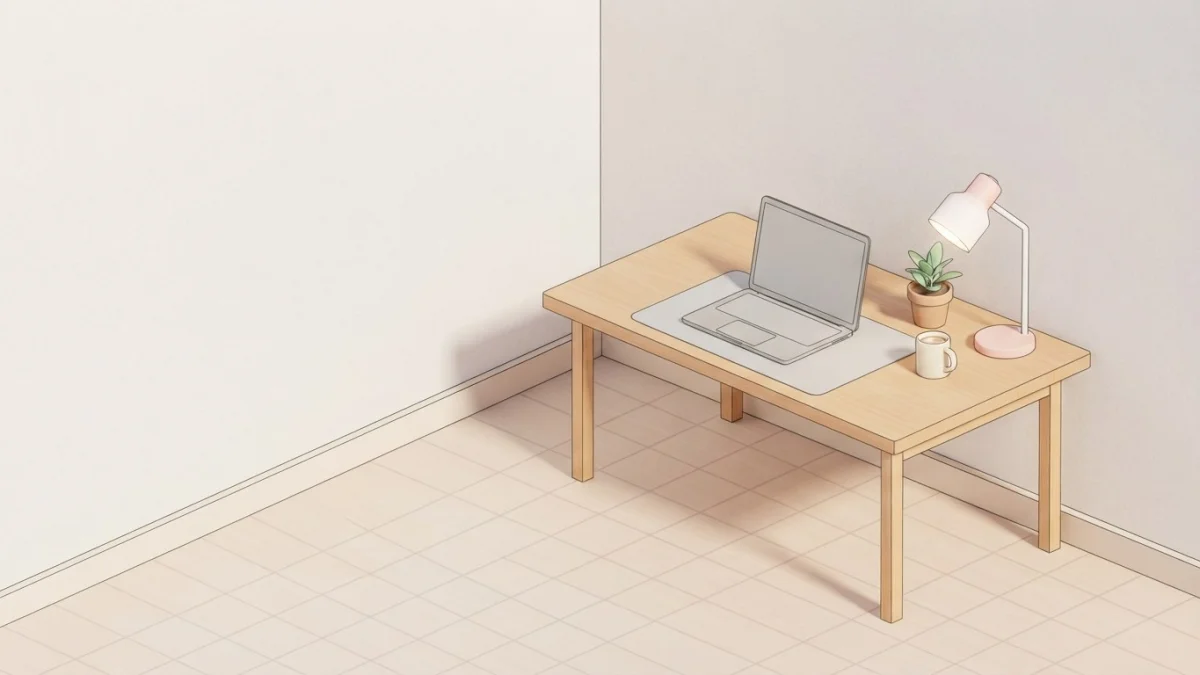
Image generated with AI.
One isometric room looks perfect. The second object is where it falls apart: the projection tilts, the shadow flips sides, the scale drifts. Here are the three promises to write into the prompt and the test that catches each one.
One isometric room looks perfect. The second object is where it falls apart: the projection tilts, the shadow flips sides, the scale drifts. Most AI isometric prompts are written for a single hero image, and an error that lives between two images cannot show up in one.
An isometric picture is a measuring system, not a style. The first image is a picture; the second one is a measurement.
Why AI Isometric Prompts Look Perfect on One Image
A single plate gets judged as a picture: does the palette work, is the mood right, does the composition breathe. Those are taste questions, and taste is what image models do best. The failures are measurement questions, invisible in a lone piece: whether the projected angles agree, whether one light dominates, whether the tile edge is the same length twice. The review you can do on one image cannot find them. What follows is three promises, one test for each, and a block you paste every time.
Promise 1 - The Projection Is Geometry, Not Style
In an isometric projection the x axis drops to the right, the y axis drops to the left and z goes straight up, with the axes 120 degrees apart. The name comes from equal measure: the same scale in all three directions. There is no vanishing point, which is why lines that are parallel in the world stay parallel on the page.
That is what makes the drawing checkable. An infiltrated perspective is not a look you can argue about; it is a wrong measurement. The usual mistake is asking for "isometric" and settling for "3D render style", a phrase about material and light that says nothing about projection. Name it out loud: orthographic, equal measure, no perspective, verticals stay vertical.
Equal Measure in Three Directions
Because nothing converges, depth does not shrink with distance. An object at the back wall keeps the size its geometry gives it. It is also how a camera gets caught: the moment two parallel edges close in, a lens got into the prompt.
The Parallel-Lines Test
On the first plate, pick two edges of the floor and one vertical of the wall, and measure their angle on the image. Repeat on the second plate. If any pair converges, the model drew a camera. Two or three degrees is invisible in one piece and obvious once the two are stacked.
The isometric cozy workspace prompt passes this test and still fails the next one: it delivers the pastel palette, the clean lines and the centered composition, and never writes the projection or the tile. It is the vignette you start from, not the room.
Promise 2 - One Key Light, Written Once
Light is not a mood you hope for; it is a field you fill in. Black Forest Labs splits its own FLUX 3 prompting guide into structure, style, lighting, text and editing: the provider says lighting deserves its own line.
Write it as a constant, never as an adjective: one soft key light from the upper left, every shadow falls to the lower right, no second light source. "Warm dramatic lighting" leaves the side of the shadow to the model, which picks per image.
The Shadow-Side Test
Pass the view over each object and note the shadow side in the set sheet. The one facing the other way gets regenerated, not flipped in an image editor: flipping also inverts letters, reflections and how the volume reads, so one fixed shadow buys you two new errors.
Why a Lone Object Brings Its Own Light
An object generated alone has nothing to be compared with. The phrase inside its prompt decides which side the shadow falls on, and prompts for single objects routinely name the light without ever naming the side. That is how pieces made separately arrive each carrying its own sun.
The catalog prompt that says the quiet part out loud is the Klein game asset icon set: its whole job is a uniform style across a family of pieces, and its solid background field is the cleanest way to isolate a prop before placing it.
Promise 3 - One Tile Is One Scale
Games with isometric maps are usually tile-based, and for tiles to match, the designer has to account for how diagonal lines land on discrete pixel steps, as this technical overview of axonometric projections explains. For a generated image the move is simpler: pick the floor tile as the unit, keep its edge length fixed, and write that unit into the prompt. Size becomes a count.
The Footprint Test
Keep one sheet for the whole set with five columns: element, footprint in tiles, height in tiles, shadow side, file name. Count, do not eyeball. A table occupying two tiles by one does not become three by two because it fits the corner better; changing the count changes the scale of the room, and every later object gets measured against the wrong ruler.
Illustrations and Tilesets Are Different Deliverables
An isometric illustration is a self-contained vignette: one composition, one framing, one plate. A tileset is a grid of reusable pieces that have to connect edge to edge. One prompt does not give you both. For the second you must state that the tile is the unit and the camera does not move, and even then the seams will probably need drawing by hand.
The Header Block: Four Lines You Paste Every Time
Same words, same order, in every generation:
- Projection: isometric projection, orthographic, equal measure in all three axes, axes at 120 degrees, no perspective, verticals stay vertical.
- Light: one soft key light from the upper left, every shadow falls to the lower right, no second light source.
- Module: the floor is built from square tiles of one fixed edge length; keep that edge length constant.
- Palette and line: pastel palette, one clean outline weight, one flat background color, no gradients on the outline.
If a generation does not carry those four lines identically, it is not the same room. It is another room with the same furniture. This block is geometry and light, not a brand style lock.
A Workflow That Survives the Second Object
- Generate the empty room first: floor, two walls, nothing else. Keep that file as the reference.
- Write the object list with a footprint in tiles and a position given as a tile, never as "in the background".
- Paste the header and generate one object per run, with its position in the prompt.
- Run the three tests after each piece: parallel lines, shadow side, footprint.
- If the geometry fails, regenerate the whole scene with the object in the prompt. Do not paste pixels across generations; that is how a room ends up with two suns.
- Name files after the element and its count, like desk-2x1-tiles.png. The name is what survives forty files.
Three Catalog Prompts and What Each One Is For
The ultra-detailed 3D character generator prompt is the occupant, and the clearest case of promise two. It lets you define character, pose, outfit, setting and color scheme, and it delivers atmospheric lighting inside that package. So the light arrives decided by the character prompt, for the character scene. Inside your room, what you inherit are the fields.
One honest warning: the cinematic, movie-grade register is a perspective camera, the opposite register to isometric. It is excellent for key art and for the character standing alone. It is not an isometric character.
What the Model Cannot Know
Your tile size in pixels, the walkable area, your hex values, which objects are game pieces and which are decoration, and whether the room has to extend tomorrow. And one honesty without softening: between two runs the model does not guarantee the same geometry. What you buy is something plausible; what you do afterwards is measure it.
FAQ
What is isometric projection in one sentence?
The three directions of space are drawn at the same scale with no vanishing point, the axes 120 degrees apart, so parallel lines stay parallel.
Do I have to say "orthographic"?
Not mandatory, but it helps. Orthographic is the word that excludes a camera, and "isometric, orthographic, no perspective" is harder to ignore than "isometric 3D".
Why does my second object look bigger than the first?
Because the scale was never declared as a module. Alone, the model sizes each piece to look good by itself. Write the footprint in tiles into the prompt.
Can I fix it later in an image editor?
You can flip a shadow or scale a piece, but each repair breaks something else: reflections, light direction, perspective. Regenerating the scene is faster than repairing it.
The room you keep is not the one that looked best on its own. It is the one where the second object measured the same as the first, and the only way to know is to run the tests.
LikePrompts Editorial
Practical guides for getting the most out of AI prompts — written by the LikePrompts team.