AI Prompts for Framed Prints: The Margin the Frame Eats
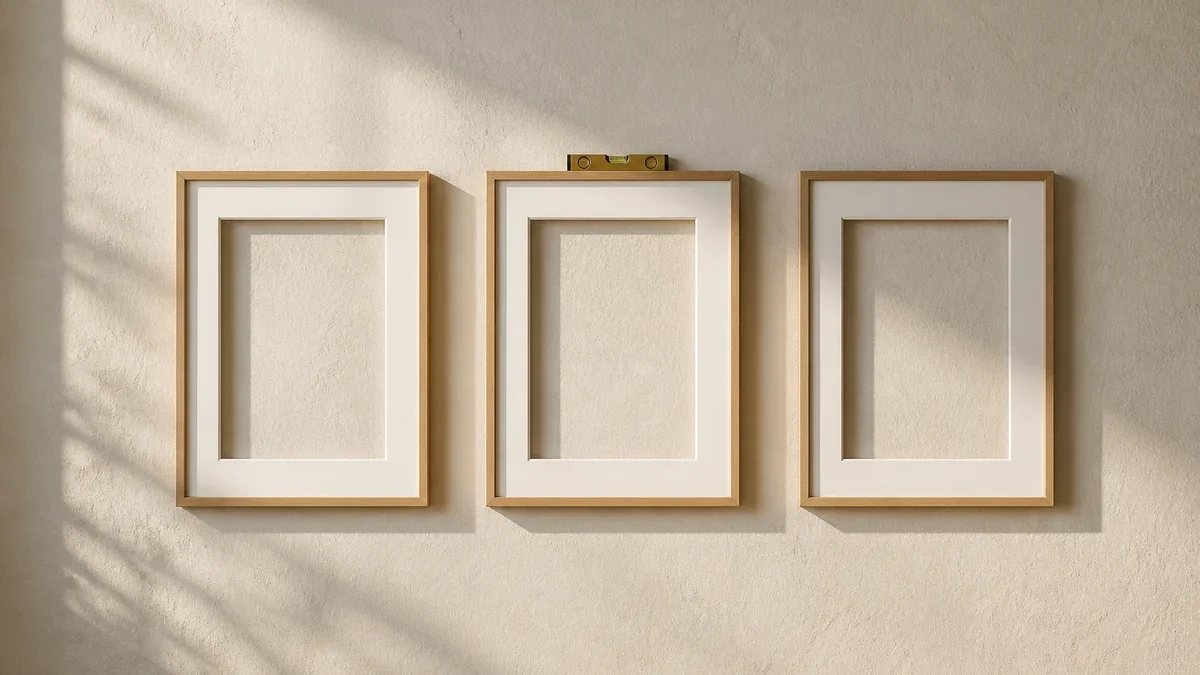
Image generated with AI.
You do not prompt a picture, you prompt a shape. The frame decides the ratio, the mat eats the edge, and three prints on one wall share a horizon.
Most AI prompts for wall art fail on the wall, not in the model. You get a handsome file in one shape, a frame in another, and a mat that quietly eats the edge. A prompt is a shape decision made twice: once for the piece, once for the hole it has to fill.
The model writes pixels; the frame decides which of them reach the wall. Between those steps sit a ratio, a mat opening and a hanging line. None of that is in the prompt yet, which is why the card matters more than the words.
AI Prompts for Wall Art: The Shape Comes First
A piece you intend to hang is not a picture, it is a rectangle with a job. You can write a beautiful scene and still lose it to a 3 cm band of board, because nothing in the request said where the subject could sit. The fix is dull and it works: decide the hole first, then write the scene into it.
The Frame Is a Shape, and It Crops
A frame does not surround an image, it crops one. Generate at one ratio and frame at another and you get two outcomes: you cut the picture, or you leave bands. The cheap escape is a family of sizes that keeps a single proportion. Every sheet in the ISO A series shares the ratio 1:1.4142, so A4, A3 and A2 change the size of the piece without changing what gets cropped (Paper size, ISO 216). Buy frames from one family and the ratio problem disappears at the source.
The Mat Eats the Edge
The mat is a second crop. Its opening is cut smaller than the frame, so the border runs on all four sides and the art stops short of the moulding by a more or less even margin. Frame calculators work the same way in reverse, setting the opening to the art and growing the frame outwards by the border (mat border calculator). The consequence is blunt: keep the subject inside the central 80 percent and never draw your own border. When a prompt asks for no borders, that instruction is leaving the margin to the mat, the only element that knows how wide it will be.
Here is the arithmetic, because roughly is how prints get ruined. A 40 x 50 cm frame with a 5 cm mat on every side leaves a 30 x 40 cm opening, taller than wide by 1.333. A piece drawn for 50 x 70 is taller by 1.4; the A series sits at 1.4142. Scale that piece to cover the opening and, at 30 cm wide, it stands 42 cm tall: the opening takes 2 cm off the height, 4.8 percent of the piece. Refuse the cut and it fits inside at 28.57 cm wide, leaving 1.43 cm of bare opening, about 7 mm per side. That is a visible band, and a decision rather than an accident.
Three Pieces, One Horizon
A set is not three good images. It is one composition with three holes in it, and it fails as a set while each piece still looks fine alone. Four things go into all three prompts, word for word:
- Where the horizon falls. Said identically each time, for example just under the middle. A horizon that drifts between pieces makes a triptych look assembled rather than made.
- Where the light comes from. One direction for the set. Two pieces lit from the left and one from the right reads as a mistake at any distance.
- The reference subject at the same size. A figure, a tree, a boat. It carries the scale.
- One palette line, pasted identically. Not a mood, a line.
The Single-Piece Test
Almost nobody buys the whole set at once. A piece that only works as the centre, half empty or with the subject sliced by the edge, is a return waiting. Look at each print alone before the group.
The Card You Write Before Any Prompt
Five lines on paper, and the prompt has somewhere to land:
- Wall. The usable width and what hangs below.
- Frame. Its size and its proportion.
- Opening. The mat inside measurement, where the art actually arrives.
- Line. The height of the centre of the group. Gallery practice puts it about 57 inches from the floor, near average eye level, as a convention rather than a law (Park West Gallery).
- Axis. Horizon, light and reference subject, in the words you will reuse.
Without that card the model picks the shape for you, and it picks one you have no frame for.
Prompt 1, the Series: Children's Book Illustration
Children's Book Illustration Style (DALL-E, $2.99) already carries the rule a set needs: the character keeps the same appearance, colours and proportions in every illustration. Warm watercolour and gouache, rounded shapes, a pastel palette, visible paper texture, no text, no borders. Today's use is the nursery wall, three prints from one story. Consistency is asked for in the text, not repaired afterwards. What it does not settle is the mat margin; that comes from the card.
Prompt 2, the Scene Field: Epic Fantasy Landscape
FLUX Epic Fantasy Landscape (FLUX, $2.99) has one field, the scene, and pins what a group must share: layers of atmosphere and fog, volumetric light, a tiny lone traveller for scale, a cinematic composition. Three scenes under one atmosphere is the fastest route to a coherent set: change the field, keep the axis. If the traveller comes out large in one piece, the set breaks even when the colour agrees.
Prompt 3, the Fixed Prompt: Fantasy Dragon Oil Painting
Fantasy Dragon Oil Painting (FLUX, $2.00) has no fields: one fixed sentence, so the same text returns the same scene. That makes it the honest counterexample. A set is not built by repeating a prompt, it is built by varying one chosen thing - framing, hour, distance - and nailing the rest. Museum quality describes pictorial register, not a fit for a 30 x 40 opening.
The Three Checks Before You Print
- The proportion check. Measure the file and the frame. If the ratios differ, decide now whether you crop or leave a band, and if you crop, count in centimetres what leaves the frame.
- The mat check. Lay a paper template of the opening over the print. Is the subject whole, and is the margin even on all four sides?
- The wall check. Three pieces on the floor at the real viewing distance, eyes half closed. If the horizon does not line up, the set is not ready, however good each piece is alone.
Where to Go From Here
Start with the piece that knows how to repeat itself: the children's book illustration prompt for a character that stays the same, or the epic landscape prompt for three scenes under one sky. To see the limit of consistency, run the fixed dragon prompt twice and watch it refuse to surprise you. The model supplies the scene; the shape, the margin and the line on the wall come from whoever hangs the print.
LikePrompts Editorial
Practical guides for getting the most out of AI prompts — written by the LikePrompts team.