AI Surface Pattern Prompts: Test the Tile Before You Trust the Motif
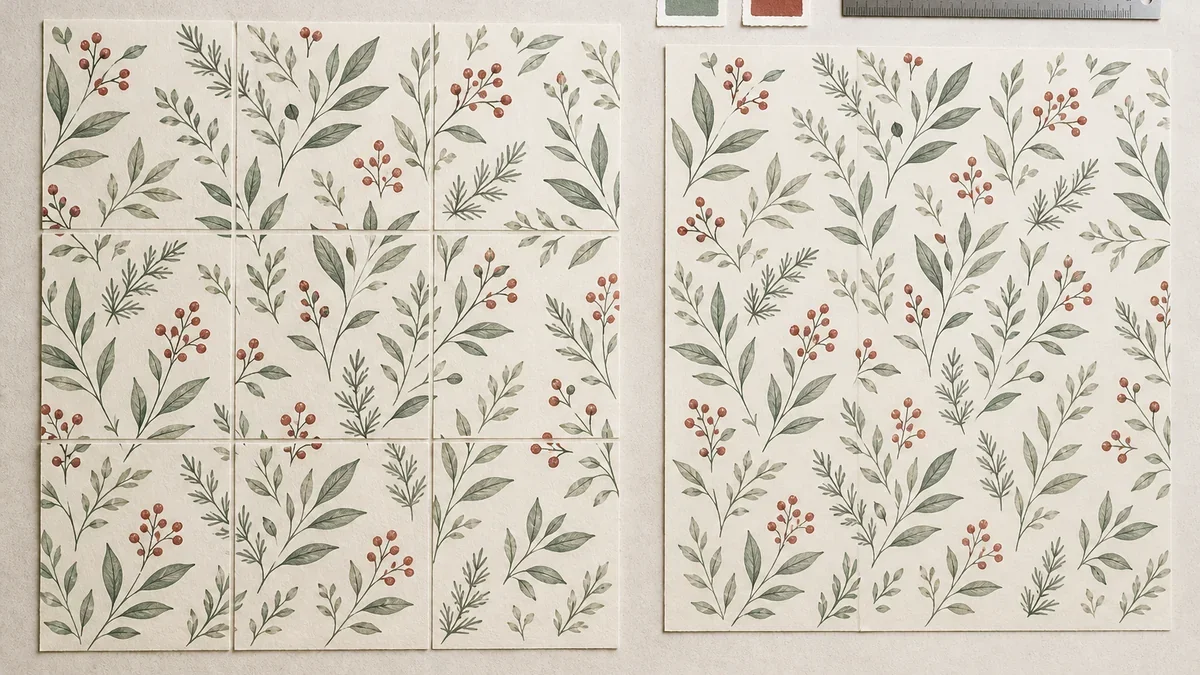
Image generated with AI.
An AI image can contain a beautiful motif and still fail as a repeat. Learn how to choose straight or half-drop geometry, write edge behavior into the prompt, and test the tile before it reaches fabric or wallpaper.
AI surface pattern prompts fail in a very specific way: the square looks beautiful and the edges do not line up. A pattern is not a motif on a canvas. It is a relationship between opposite edges, and that relationship is either written into the prompt or left to chance.
AI Surface Pattern Prompts Start With the Repeat, Not the Motif
The usual prompt describes a subject: botanical leaves, small berries, a soft palette, an elegant style. The model delivers something attractive, you save it, and later it goes onto fabric and the illusion collapses. Nothing in that prompt asked for repetition.
A Square That Looks Patterned Can Still Fail
Decoration is easy to generate. Periodicity is not. For a tile to repeat, whatever leaves the right edge must re-enter on the left at the same vertical position, and whatever leaves the top must continue on the bottom. If a leaf is cut mid-edge on the right, the same leaf has to be waiting at the same height on the left. If it is not, every join shows a seam.
An image model can produce a convincing distribution of shapes and still miss that condition. It sees a pleasant arrangement of objects, not a periodic function. That is why generated patterns look correct as a single thumbnail and broken once you place two side by side.
Pick the Repeat That Serves the Motif
A straight or block repeat keeps every column aligned. All joins fall on the same lines, which makes inspection simple, and it suits geometric motifs, tight all-over textures, and anything with a strong horizontal or vertical rhythm.
A half-drop repeat shifts alternate columns by half the tile height. The offset breaks the grid and hides the mechanical feeling a block repeat creates with organic shapes such as florals or scattered foliage. The cost is that you now have two kinds of join to check.
Name the format, but do not assume the model enforces it mathematically. The format word is a hint about arrangement. The visual test below is what confirms the choice.
Write AI Surface Pattern Prompts as a Tile Specification
A prompt that behaves like a production spec is concrete where it matters. Instead of atmosphere, describe the structure: what repeats, at what scale, in what orientation, with how much empty ground, and what happens at the borders.
Name the Motif and Its Negative Space
Pick one motif family and commit: a single leaf shape, a two-flower cluster, a berry sprig. Set a scale range, because small and medium flowers produce very different densities, and state the orientation, since a motif that always points up behaves differently from one rotated at random.
Negative space needs its own sentence. "Balanced density" is not an instruction. A generator can balance on average while leaving one corner crowded and the opposite edge empty, and a crowded corner becomes a visible blot when the tile repeats. Name the empty ground explicitly and set a margin except where a motif deliberately crosses the boundary.
State Edge Behavior in Plain Language
This is the sentence most pattern prompts are missing. Write it in ordinary words: motifs crossing the left edge continue at the same height on the right, motifs crossing the top continue on the bottom, and the continuity holds at 100 percent zoom. For a half-drop, add that alternate columns are offset by half the tile height and that the offset stays consistent.
Keep "seamless" in the prompt, but treat it as a requirement rather than the only instruction. The word states the goal; the edge sentence describes the behavior. Models respond better to a described behavior than to a single adjective, and you still verify the result yourself.
Keep the Surface Flat When the Product Needs It
Surface pattern artwork is not a product photograph. For fabric, wallpaper, or stationery, ask for a flat composition with even, restrained light: no cast shadows, no perspective, no horizon, no vignette, no depth of field.
Any scene cue inside a repeat becomes a repeating error. A soft shadow reads as natural once and as a stripe across the whole surface. A slight perspective makes every tile lean. Flatness here is a structural requirement, not a stylistic preference.
Three Catalog Prompts as Three Different Tests
The store's prompts are useful because they are specific about constraints, and specificity is what a repeat needs. Each of these three teaches a different lesson.
The Direct Seamless Pattern Prompt
Surface Pattern Designs is the closest baseline in the catalog. It takes a motif, a style, and a palette, then explicitly requests seamless repetition, elements flowing across the seam, a flat composition, balanced density, and no text or watermark. That is already a tile specification in miniature, and a sensible starting point for fabric or wallpaper concepts.
Use it and then test it. Asking for "tileable on all edges" is a request, not a certificate.
The Minimal Motif Constraint
Logo Design System for ChatGPT is not a repeat prompt, which is why it is instructive. Its constraints limit shape complexity, cap the palette at two colors, forbid gradients and photorealism, and demand a centered mark with a scalable silhouette.
Those limits are a corrective when a repeating motif turns noisy. If your tile starts collecting detail nobody will see at fabric scale, borrow the discipline: fewer shapes, fewer colors, stronger silhouette. Just do not expect a logo prompt to deliver a seamless tile.
The Detail-Density Contrast
Appetizing Food Photography shows the opposite extreme. Its recipe depends on a 45-degree view, side window light, steam, scattered ingredients, a textured surface, and shallow depth of field. Every element builds a scene, and a scene and a tile are incompatible.
Angle, steam, scattering, and blur all signal a single moment. When adapting a motif for a surface, strip them out deliberately. The composition becomes flatter and less exciting, and that is the correct trade.
The 3x3 Tile Test Before Production
Before anything goes to a supplier, duplicate the square into a three by three grid. Nine copies expose almost every problem in under a minute.
Test the Opposite Edges
Inspect every vertical and horizontal join at 100 percent zoom. Follow one line, leaf, or berry across a seam: it should not jump, stop, change scale, or shift color. Then look at the grid at thumbnail size, because some discontinuities disappear up close and become obvious small.
Test the Rhythm, Not Only the Seam
A clean seam is necessary and not sufficient. Look for accidental stripes from aligned motifs, four-corner collisions where shapes from four tiles pile onto one point, one focal motif repeating too obviously, and empty bands where density drops. A perfect join can still produce a badly spaced pattern.
Test the Intended Surface
Preview at roughly the motif scale of the real product. A pattern that looks delicate on screen can turn tiny and noisy on a cushion, or oversized and clumsy on a wall. Check a single repeat, a small crop, and a distance view.
Record the Handoff
Write down the motif description, repeat format, tile dimensions, palette, intended scale, and any defect you accepted. That record lets a designer or supplier reproduce the surface without guessing. Export only after the tile passes the visual test.
What AI Cannot Guarantee
A prompt cannot guarantee pixel-perfect edge correspondence, print color, textile registration, resolution, vector editability, or licensing. The model can write "half-drop" and apply an inconsistent offset, add a shadow that breaks a flat surface, or line up one axis and fail the other.
For continuity and repeat behavior, the Texloom explanation of seamless pattern repeat types is a plain-language reference, and the Fabrixa fabric repeat guide covers what the tile means once it becomes a roll of material. Neither replaces an inspection of your own output or your supplier's specifications.
Treat generated artwork as a strong draft of a surface, not a finished production file. Human checks and the printer's own requirements stay part of the job.
FAQ
Is "seamless" enough in an AI prompt?
No. It states the goal without describing the behavior. Add the edge condition and inspect a repeated preview before you use the tile.
Should every pattern use half-drop?
No. Choose based on the motif's rhythm and the destination surface. When you are unsure, generate both and compare them at 3x3.
Can I send the generated square directly to a printer?
Not without checking dimensions, resolution, color workflow, file format, and the supplier's own requirements.
LikePrompts Editorial
Practical guides for getting the most out of AI prompts — written by the LikePrompts team.