Prompt Chaining: How to Break Big Tasks Into Small Prompts
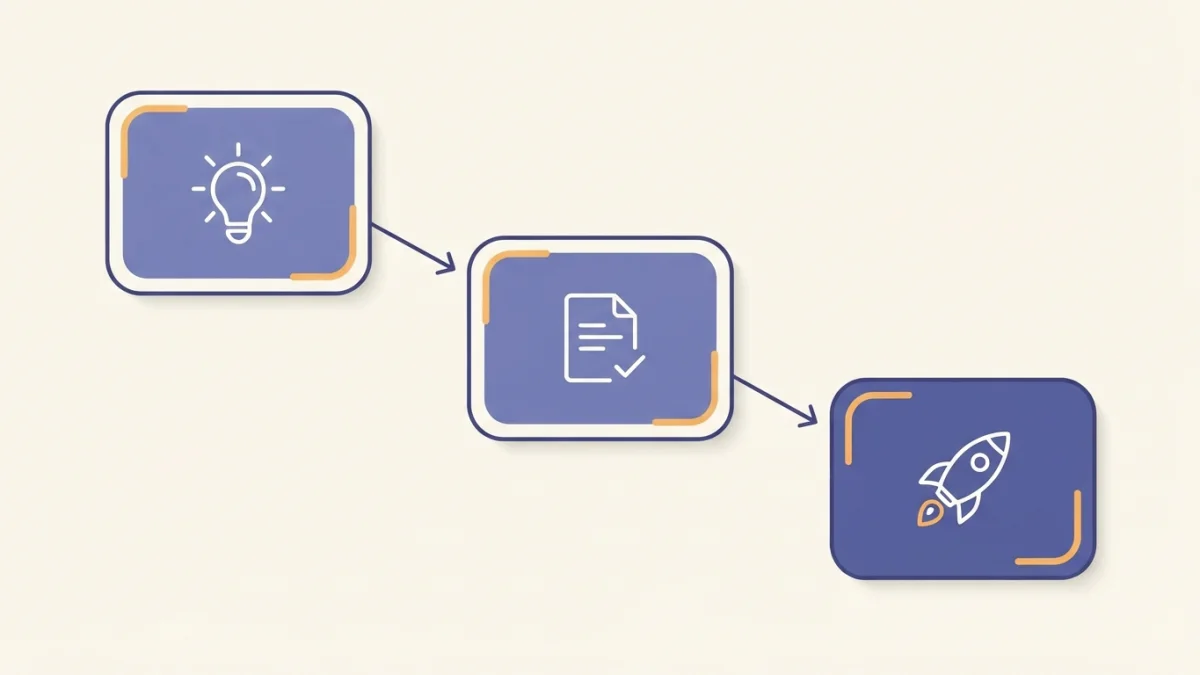
Image generated with AI.
One giant prompt gives you a messy answer. Prompt chaining splits the job into small steps - research, draft, polish - and each step feeds the next. Learn the pattern with real ChatGPT, Claude and Gemini workflows.
One giant prompt gives you a messy answer. Prompt chaining splits the job into small, sequential steps - research, draft, polish - and each step's output feeds the next. Learn how to break big tasks into small prompts with real ChatGPT, Claude and Gemini workflows.
Why One Giant Prompt Fails
When you paste a huge request into a single prompt, you are asking the model to do several jobs at once: gather information, decide a structure, write the text, check the tone, and format the result. Every sub-task competes for attention and for space inside the context window. The output usually reads like a draft that tried to be everything and mastered nothing. Prompt chaining solves this by splitting the work into focused, sequential steps, each with one purpose.
The Context Window Gets Crowded
Large language models process a limited amount of text at a time, and a single enormous prompt fills that window quickly. Models lose information from the middle of long conversations - exactly where you often placed your most important instructions. Shorter, focused prompts keep the window clean, use fewer tokens per step, and cost less.
You Cannot Debug a Black Box
If a giant prompt produces a wrong answer, where do you start? The failure could come from research, structure, tone, or formatting, and you have no way to tell which part broke. With a chain, each step has a clear output you can inspect - you see exactly which step failed and repeat only that one.
What Prompt Chaining Actually Is
Prompt chaining - also called sequential prompting or multi-step prompting - decomposes a complex task into a series of simpler sub-tasks, each handled by a dedicated prompt. The output of each step becomes the input of the next one, building the final result progressively.
One Job Per Step
In a chain, every step has exactly one job, and the model's attention is not split. Instead of asking for a complete article in one go, you ask first for an outline, then for a draft of each section, then for a polish pass. Each of those is a simple request the model can handle well.
Output Becomes Input
The mechanism that makes chaining powerful is data flow: the output of step one becomes the input for step two, and so on. The outline produced in the first step is pasted into the second prompt as its instruction. You build the context yourself, step by step, instead of asking the model to remember everything.
Prompt chaining is not the same as chain-of-thought. Chain-of-thought asks the model to reason step by step inside a single answer, a technique described in the Prompt Engineering Guide. Prompt chaining uses separate prompts executed in sequence, where you (or a script) pass the output of one to the next.
When to Chain - and When Not To
Chaining is a tool, not a rule. It shines on long, multi-stage work and adds nothing but overhead on trivial tasks.
Chain Long, Multi-Stage Work
Research, draft, polish. Outline, write, edit. Any task with clearly separated phases is a good candidate, because each phase can be validated and improved independently. Chaining also improves reasoning on complex problems: each stage reasons about a bounded input instead of a wall of text, which reduces hallucination because the focus stays narrow.
Keep Short Tasks Single
Summarizing a paragraph, translating a sentence, or rewriting a headline does not need a chain. The overhead of multiple steps adds no value when the whole task fits in one prompt. If you can describe the task in one sentence and the output in one paragraph, keep it single.
A Worked Example: The Content Pipeline
The easiest chain to understand is the content pipeline: outline, draft, polish - three prompts, each producing something you can review before moving on.
Step 1 - Outline First
Start with a prompt that generates structure instead of a full article. A good outline prompt returns a title built around your keyword, a meta description, five H2 sections with sub-headings, and a short FAQ. The SEO article outline prompt does exactly that in one structured pass.
Step 2 - Draft Section by Section
Take the outline and paste it into a second prompt: "Write each H2 section in 300-400 words." One short call per section instead of one giant call for the whole article: each section is easier to review, easier to fix, and less likely to drift off-topic.
Step 3 - Review and Polish
Finally, run the full draft through a review prompt with explicit criteria: tone consistency, keyword placement, and smooth transitions. This step catches problems that individual drafts cannot see, because it looks at the article as a whole.
Prompt Chaining in Claude: The Step Protocol
Anthropic's prompt engineering best practices recommend structure, examples, iteration, and orchestration techniques for complex systems, and Claude's platform documentation covers chaining for multi-step work. The clearest real-world example is the step protocol used to build applications.
Requirements, Plan, Build, Harden, Test
The Claude App Builder (Spec to Code) prompt runs a disciplined five-step chain. Step 1 gathers requirements with clarifying questions. Step 2 proposes a plan - stack, data model, page structure - and stops for your approval. Step 3 builds the app in small verifiable chunks. Step 4 hardens it with error handling, validation, and edge cases. Step 5 writes and runs the essential tests and reports failures honestly.
Make the Model Wait for Your Approval
The instruction that turns this prompt into a real chain is "do not skip ahead." The model does not jump from requirements to code in one go; it waits at each checkpoint for your input. That explicit gate separates a disciplined chain from a prompt that lists steps and then does everything at once.
ChatGPT Chains You Can Buy Off the Shelf
Some of the most popular ChatGPT prompts are packaged chains, and the pattern is worth stealing even if you never buy one.
Phase-Based Book Writing
The Complete Book Writing System prompt runs by phases. Phase 1 covers the concept: a one-sentence premise, the reader transformation, three comparable books and how yours differs, and a back-cover hook. Phase 2 produces a chapter list with a one-paragraph summary and an emotional arc per chapter. Only after approval does the chain draft chapter by chapter, then edit, then build the publication plan. Its rule is "one phase at a time - do not jump ahead," the same gate discipline as the Claude protocol.
The Course Creator Pattern
The same phased structure powers course creation: curriculum, scripts, slides, worksheets, and launch plan, each phase feeding the next. "Phases" plus "do not jump ahead" in a prompt description means someone already designed the step sequence for you.
Three Rules for Clean Chains
Whatever chain you build, these three rules keep it fast, cheap, and maintainable.
Pass Only What the Next Step Needs
Do not re-send the entire conversation history to every step. Pass a summary of the context instead - large contexts increase cost and raise the risk of leaking sensitive data. A chain step should receive a bounded, relevant input: the outline for the drafting step, the draft for the review step, nothing more.
Save Every Output Between Steps
The output of each step is the input of the next one, so save it. Copy it to a file or paste it into a document. If you lose the output of step two, you cannot run step three without redoing step two. Treat every checkpoint as a deliverable you keep.
Keep Your Steps as Reusable Prompts
Design each step as a standalone prompt you can reuse. "Write each H2 section in 300-400 words" works for any article. Build a small library of step prompts - outline generator, section drafter, reviewer, FAQ writer - and your chains become fast to assemble.
Three Prompts That Are Already Chains
You do not have to design chains from scratch. These catalog prompts already implement complete sequences, and buying one saves you the design work:
- SEO Article Outline - a one-pass structured chain for title, meta description, H2/H3 skeleton, and FAQ ($2.00).
- Claude App Builder (Spec to Code) - the five-step requirements-plan-build-harden-test protocol with approval gates ($4.99).
- Complete Book Writing System - the phased concept-to-publication chain for books ($9.99).
- Gemini Product Comparison Research - an implicit chain that researches with live search, structures the comparison table, then decides with a clear verdict ($2.99).
Common Chain Mistakes
Chaining fails when you apply it mechanically. Too many steps: a ten-step chain for a task that needed three adds latency and complexity. Giant steps: a "step" that still asks the model to do five things at once defeats the purpose. Missing checkpoints: if you never review intermediate outputs, you are just running several giant prompts in a row. Re-feeding the full history: passing everything to every step wastes tokens, raises cost, and risks leaking data. Keep steps small, review each output, and pass only what the next step needs.
LikePrompts Editorial
Practical guides for getting the most out of AI prompts — written by the LikePrompts team.